






UAE: The Middle East conflict has demonstrated the UAE’s resilience and ability to adapt quickly to changing circumstances, strengthening its position as a global financial and trade hub, according to a senior Citi executive.
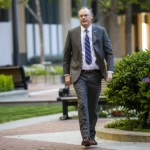
“The conflict has strengthened the UAE. It turns out that the UAE was a lot stronger than what people believed, and incredibly quick in adapting to this new reality,” said Ernesto Torres Cantú, Citi’s Head of International, in an interview with Khaleej Times.
He said some sectors could take longer to return to conditions before March, but expressed confidence that they would recover.
Citi raised $28 billion (approximately Dh102.76 billion) for clients in the UAE during the first eight months of 2026. Across the Gulf region, the bank’s financing reached $75 billion (Dh275 billion) over the same period.
UAE Remains Central to Global Trade and Finance
Torres Cantú said the UAE remained strategically positioned at the centre of international trade and financial flows, even as regional disruptions changed established routes.
He cited the example of a company supplying goods to the Gulf Cooperation Council (GCC) that previously transported cargo through the Strait of Hormuz but had shifted to three alternative ports, with shipments arriving through the Mediterranean.
“The flows change, the direction may change, but it will remain in the centre,” he said, adding that the UAE was well placed to maintain its role in global trade and finance.
Citi has operated internationally for more than 200 years and has been present in the UAE for 62 years. Torres Cantú described the country as the bank’s largest franchise in the region and said Citi remained committed to expanding alongside the UAE.
He also stressed the importance of adapting continuously to changing market conditions and client needs.
Citi Reaffirms Commitment Following Regional Crisis
Torres Cantú’s visit to the UAE was intended to meet employees and clients and reaffirm the bank’s support following the regional conflict.
He said Citi wanted to demonstrate its commitment through concrete financial support, rather than words alone.
The bank’s first priority during the crisis was the safety and wellbeing of its employees, followed by supporting clients, he said.
Citi was unable to use its offices for a period, prompting staff to work remotely. Around 300 employees across the region were asked to return to their home countries, with the bank assisting them with the arrangements. The number of employees affected in the UAE was minimal, according to Torres Cantú.
He said Citi continued supporting clients throughout the disruption.
UAE-US Investment and Blockchain Services
Citi recently integrated the UAE into its Citi Token Services network, which enables blockchain-based transfers of money. The network also includes the United States, the United Kingdom, Ireland, Japan, Hong Kong and Singapore.
Torres Cantú said the move reflected the importance Citi attaches to the UAE and its growing connections with other markets.
He added that the bank was working with UAE sovereign wealth funds on investment commitments announced during US President Donald Trump’s visit in 2025, which were reported at $1.4 trillion.
Priority areas include artificial intelligence, infrastructure, engineering and data centres.
Citi is also helping facilitate investment flows between the Gulf and the United States, he said, highlighting the value of the bank’s international network to major institutional clients.
Global Growth Faces Pressure from Higher Costs
Discussing the global economic outlook, Torres Cantú said supply chains had started shifting during the Covid-19 pandemic, when countries and companies recognised the risks of relying heavily on a single location.
Tariffs and geopolitical conflicts have accelerated the trend, making resilience and alternative plans increasingly important for businesses and governments.
According to Citi, global economic growth is tracking at around 2.7 per cent this year, below the nearly 3 per cent previously anticipated.
Torres Cantú said higher oil prices had contributed to inflationary pressure and rising interest rates, increasing the cost of capital for businesses and governments.
He described the emerging global economic balance as inefficient, noting that the effects of higher borrowing costs would vary across sectors and countries.
AI Boosts Productivity and Cybersecurity
Torres Cantú identified three key areas in Citi’s approach to artificial intelligence: improving efficiency, strengthening cybersecurity and developing employees’ skills.
He said AI was helping shorten tasks that previously took days or weeks to just minutes.
Employees who actively use AI in their daily work could significantly increase their productivity, he added, with some tasks potentially delivering the equivalent of twice the output.
Citi is also focused on protecting its systems against emerging AI-related cybersecurity threats. Torres Cantú said the bank obtains access to AI models before their wider release so it can assess potential risks and strengthen its defences.
He said the bank would continue investing in employee capabilities and security measures as AI technology develops.
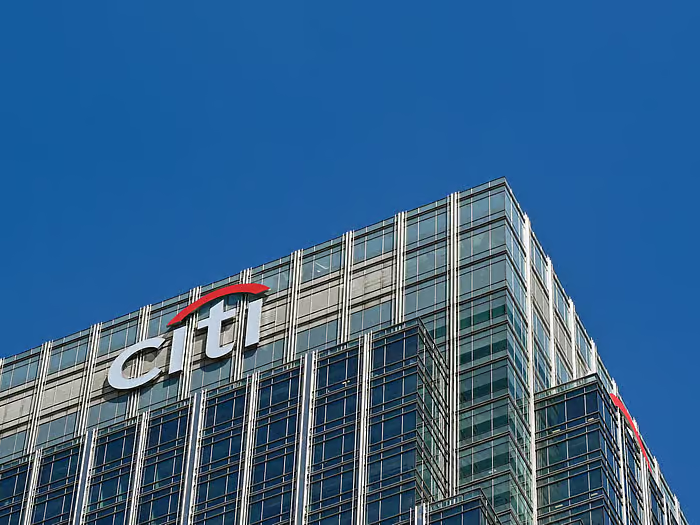
Image caption: Citi’s financing across the Gulf reached $75 billion (Dh275 billion) during the first eight months of 2026. Photo: Cerib / stock.adobe.com.